
Under-Construction vs Ready-to-Move Residential Property: Which Is Better for Buying a Home
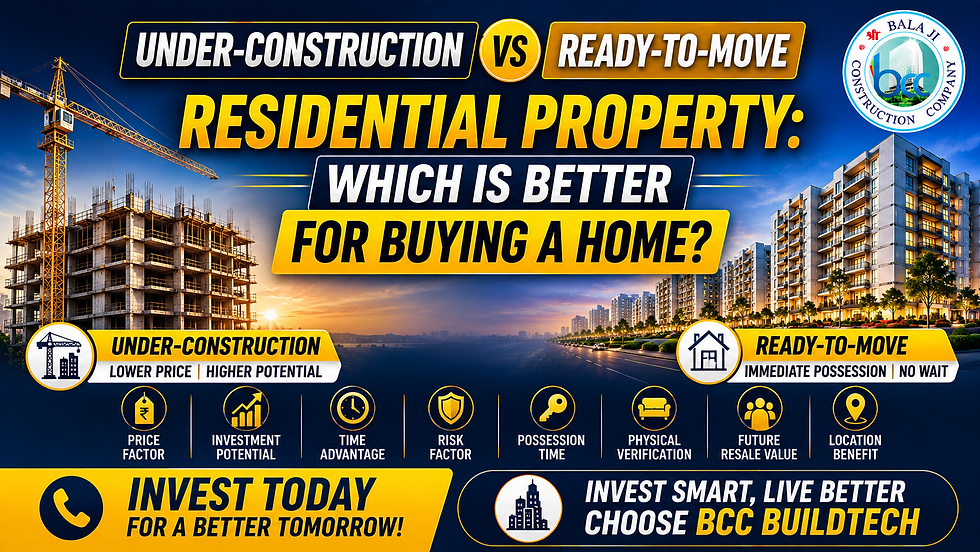
Purchasing a house is one of the most important decisions made by an individual in his or her life, and one of the first decisions at this crossroad is whether you want to invest in an under construction property or a move-in ready property.
There are merits to each choice as there are people who swear by both these choices. An under construction flat will be more economical and give you the advantage of customization, whereas a move-in ready property means getting the luxury of moving into your new home without any delay or hassles. But what’s the best fit for you then?
Let's take a look at both these aspects from the perspectives of price, risk, tax, home loan, and possession.
What Is an Under-Construction Property?
Under Construction Property is a house that is currently being built by the developer. This is where you will buy the apartment at a very early stage - maybe even before laying the foundation - and make payments on a regular basis as the construction goes on.
What Is a Ready-to-Move Property?
In contrast, a ready-to-move property is one wherein the residence is finished and has already obtained an occupancy certificate (OC), hence ready for immediate occupation. You will be getting exactly what you see in the site visit without having to wait for anything.
Difference Between Under-Construction vs Ready-to-Move Property
Parameter | Under-Construction Property | Ready-to-Move Property |
Price | Generally lower, often 10–30% cheaper than similar ready homes | Higher, as the developer's cost and risk are already absorbed |
GST | Applicable (usually 5% for non-affordable housing, 1% for affordable housing) | No GST if the project has received its Occupancy Certificate |
Possession Time | Delayed possession is common; can take 2–5 years or more | Immediate possession, move in right after purchase |
Risk Factor | Higher risk of construction delays or project stalling | Minimal risk since the property already exists |
Customization | Buyers can often request layout or finishing changes early on | Little to no scope for customization |
Home Loan Disbursement | Loan is disbursed in stages as construction progresses | Full loan amount is disbursed at once |
Rental Income | No rental income until possession is handed over | Can be rented out or self-occupied immediately |
Property Inspection | Based on brochures, sample flats and floor plans | You can physically inspect the exact unit before buying |
Price Appreciation | Higher potential for appreciation as the project nears completion | Comparatively slower appreciation as the price is already matured |
Legal Documentation | RERA registration and approvals need careful verification | Documentation is usually complete and easier to verify |
Advantages of Buying an Under-Construction Property
Cheaper Purchase Cost Developers set the cost of purchase lower in order to attract early buyers and to fund their further development. This difference can mean significant savings, particularly when it comes to the development of residential complexes.
Easier Payment Schemes There are many different payment schemes available in projects that are not yet finished, including the scheme of financing tied to the course of development and subvention payment scheme.
Selection of Units By booking the unit early, you get the opportunity to choose your floor number, aspect ratio and layout. Such choice will be very limited in the case of purchasing the apartment in an already finished complex.
Opportunity to Gain From Appreciation The project is developing and the value of real estate located there is growing. Early buyers get the opportunity to enjoy the appreciation of their property even before its purchase.
More Modern Amenities Under construction projects are usually more modern than ready-to-move apartments and houses.
Advantages of Buying a Ready-to-Move Property
No Waiting Period There will not be any waiting period for you and you may shift once the documents are sorted out. This is beneficial for the people who need a house on an urgent basis.
The Real View Since the house is constructed already, there will be no problem in viewing the real property, the quality of construction and everything else that might influence your decision.
No Liability of GST There will be no liability of GST as far as ready-to-move properties are concerned which will save you money.
Early Rental Income If you have bought the property as an investment, then it can fetch rental income immediately without having to wait for the construction.
No Risk There will be no risk for you since the house already exists.
Which One Should You Choose?
Of course there’s no single formula that fits all – it very much depends on your individual needs.
Go for a newly constructed home if:
You’re not pressed for time and willing to wait until moving into your new home.
Cost saving is one of your major concerns.
You like to make adjustments to your future home.
You're ready to do research on the builder and RERA norms.
Select a turnkey property when:
You require prompt occupancy.
You like zero risk in construction and want to inspect before purchasing.
You purchase the property mainly for rental income.
You wish to avoid GST and make the tax-benefit process easy.
Things to Check Before Buying Either Type of Property
RERA Registration – Make sure that the property is registered according to RERA.
Reputation of Builder – Check the history of projects undertaken by the builder along with their timely delivery and construction quality.
Location and Connectivity – Determine the proximity of the property to schools, hospitals, office, and modes of transportation.
Ownership Status and Approvals – Ensure that the property has proper land ownership rights, building approvals, and occupancy certificate (in case of ready property).
Total Cost of Purchase – Consider the cost incurred after adding GST and stamp duty while comparing prices.
Final Thoughts
Both the under construction homes and ready to move homes have their own advantages, and which one should be the "right choice" depends totally on your time frame, budget, and investment objective. If you give priority to cost-effective and customized home construction, then an under construction house from a well-known and RERA approved builder will prove to be a better option.
Regardless of which option you select, having a trustworthy and competent developer will be key to guaranteeing a smooth and transparent process.
If you are seeking quality and thoughtfully planned residential construction projects within your budget, then BCC Buildtech has got just what you are looking for.
Frequently Asked Questions (FAQs)
Is it advisable to invest in a property which is under construction in India?
Yes, but only if the project is registered with RERA and the developer has a good reputation.
Is the cost of an under-construction property lower than that of a ready-to-move property?
Yes, an under-construction property will be much cheaper, sometimes up to 10-30%. This is because it comes with certain risks associated with the construction period.
Should I pay GST on a ready-to-move property?
No, there is no need to pay GST on a ready-to-move property if it has been granted occupancy certificate.
Can I take a home loan for under-construction property?
Yes, nearly all banks and NBFCs provide a home loan for under-construction property in a stage-wise manner according to the payment structure.
What will happen if the project gets delayed?
According to the Real Estate Regulatory Act (RERA), the developer is responsible to compensate or pay interest to the buyer for any delay beyond the delivery date of possession.


This is a very informative comparison of under-construction and ready-to-move properties. The points about cost, possession, GST, customization, and RERA checks are especially helpful for homebuyers. Understanding these factors can make it much easier to choose the right residential property based on budget and long-term goals.